
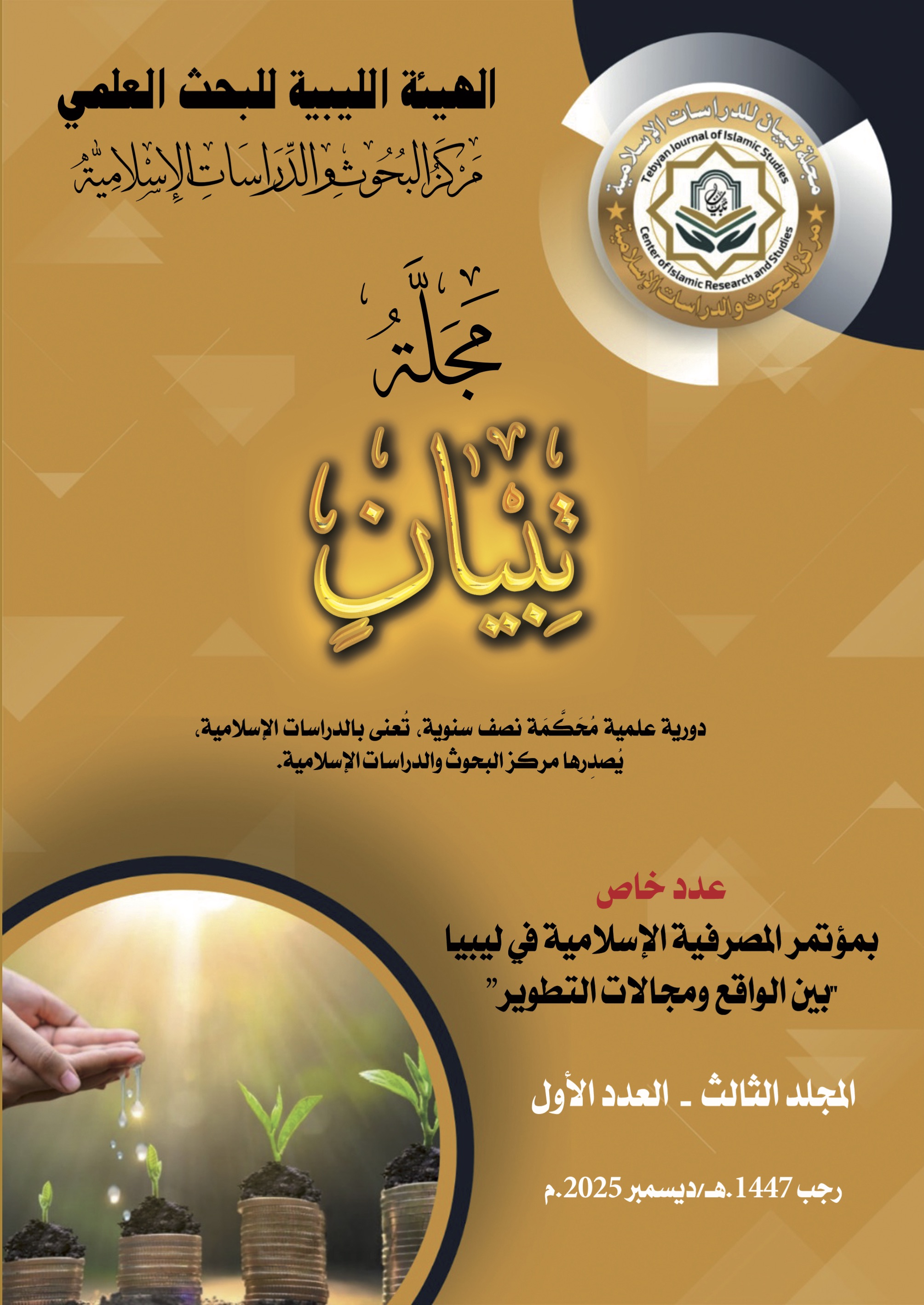
The Challenge of Converting Conventional Banks to Islamic Banks in Libya: A Comparison Between the Requirements of Islamic Banking and Libyan Legislation.
Abstract
Traditional banking into Islamic banking in Libya through an approach that requires the availability of Islamic and Libyan legislation, in light of the controversy over the nature and regulation of Libyan banking between total and partial transformation or a dual system. The research aims to analyze the framework of the transformation, focusing on the Law No. (1) Final of 2013 Prohibiting Usury Transactions and its amendments pursuant to Law No. (35) Final of 2023, which allowed the law prohibiting usurious transactions despite the provision prohibiting usurious transactions. The research concluded that the real transformation to the Islamic system in Libya is still partial, as it is institutional, and requires the completion of the Sharia, legal and regulatory requirements in order to be able to fully meet the standards of Islamic banking
Downloads
References
Downloads
Published
Issue
Section
License

This work is licensed under a Creative Commons Attribution-NonCommercial 4.0 International License.
Authors are the copyright holders and grant Tebyan Journal of Islamic Studies copyright to their works licensed under the Creative Commons Attribution-NonCommercial (CC-BY-NC) licenses. This allows others, with acknowledgement of authorship, to quote, remix, and build upon the work noncommercially (for example, by publishing it in a book or posting it in an institutional repository) as long as they acknowledge Tebyan Journal of Islamic Studies' prior publication.